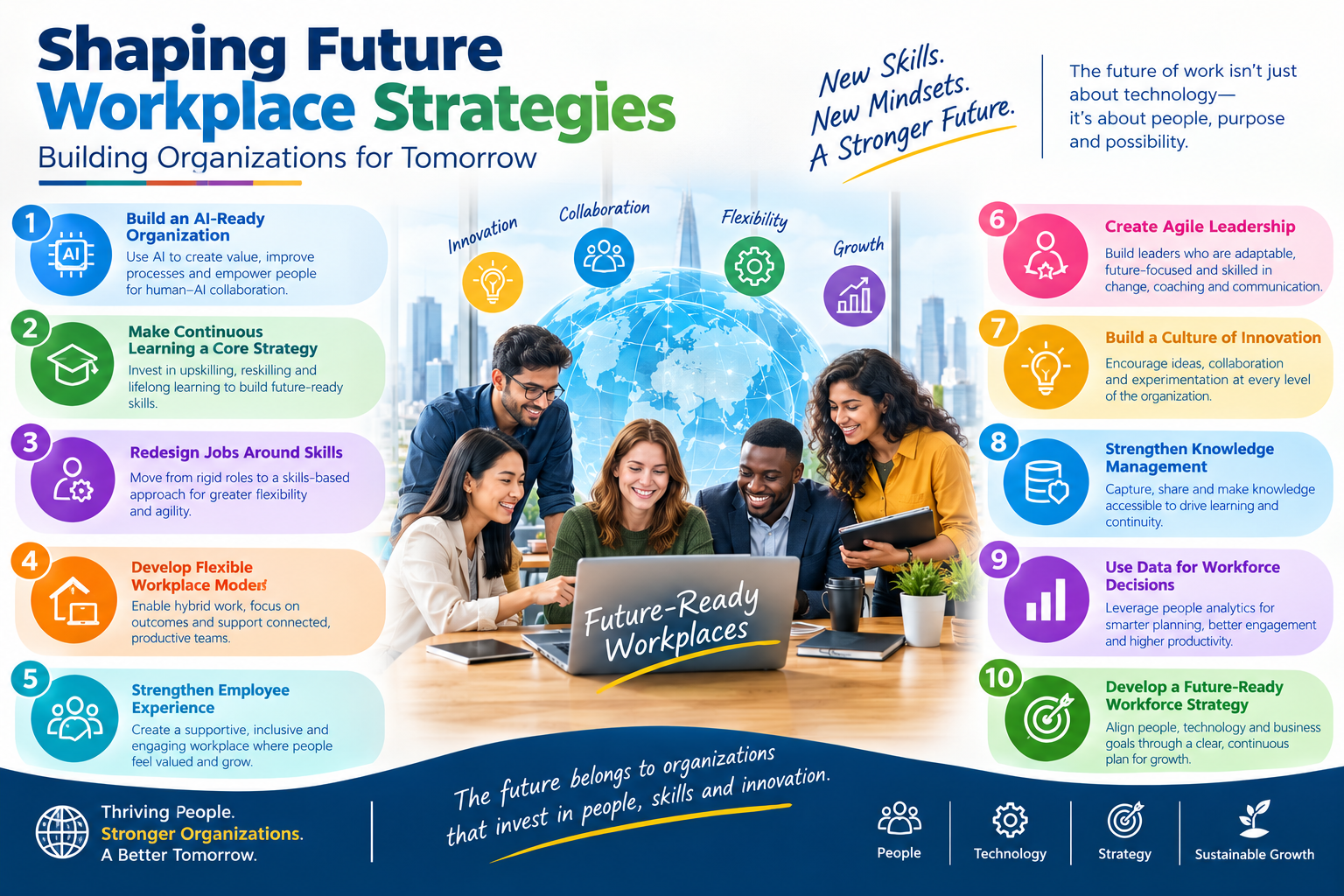
Shaping Future Workplace Strategies: Building Organizations for Tomorrow
The workplace is undergoing one of the most significant transformations in modern business. Artificial intelligence, automation, changing employee expectations, hybrid work, demographic shifts, and rapidly evolving skills are changing how organizations attract talent, organize work, develop employees, and create value.
For organizations, preparing for the future is no longer simply about adopting new technology. It is about creating a workplace that can continuously adapt to changing business conditions while enabling people to perform, learn, innovate, and grow.
The World Economic Forum’s Future of Jobs Report 2025 identifies technological change, economic uncertainty, demographic shifts, the green transition, and geoeconomic changes as major forces shaping the global workforce through 2030.
So, how can organizations shape effective future workplace strategies?
1. Build an AI-Ready Organization
Artificial intelligence is becoming an important component of modern business operations. Organizations are increasingly using AI for recruitment, customer service, data analysis, marketing, knowledge management, productivity, and decision support.
However, successful AI adoption requires more than purchasing software. Organizations need to identify where AI can create meaningful business value, redesign processes where appropriate, establish responsible-use principles, and train employees to work effectively with AI.
The World Economic Forum reports that 86% of surveyed employers expect AI and information-processing technologies to transform their businesses by 2030.
Future workplace strategies should therefore focus on human-AI collaboration, rather than viewing technology and employees as separate systems.
2. Make Continuous Learning a Core Strategy
One of the biggest challenges facing organizations is the rapid change in skills.
The World Economic Forum estimates that 59 out of every 100 workers would require training by 2030 based on the expected evolution of workplace skills. AI and big data, cybersecurity, technological literacy, creative thinking, resilience, flexibility, and lifelong learning are among the areas expected to become increasingly important.
Organizations should therefore move from occasional training programs toward continuous learning ecosystems.
This can include:
Upskilling programs
Reskilling initiatives
Leadership development
AI literacy
Mentoring and coaching
Digital learning platforms
Cross-functional projects
Internal mobility programs
Learning should become part of everyday work rather than an activity employees complete only once or twice a year.
3. Redesign Jobs Around Skills
Traditional organizations often structure employees around fixed job descriptions. Future organizations may increasingly need to think in terms of skills, capabilities, projects, and outcomes.
As technology changes the way tasks are performed, some responsibilities may disappear while new responsibilities emerge. Gartner describes this as a broader impact of AI on jobs and organizational structures, requiring leaders to anticipate how changes in technology can affect workforce needs.
A skills-based approach can help organizations identify:
What capabilities they have today
What capabilities they will need tomorrow
Where skill gaps exist
Which employees can be developed
Which roles may need redesigning
This creates a more flexible approach to workforce planning.
4. Develop Flexible Workplace Models
The future workplace does not necessarily mean fully remote or fully office-based work. Different organizations, functions, and employees may require different working arrangements.
Hybrid and flexible models can allow organizations to combine collaboration, employee autonomy, productivity, and organizational culture.
Future workplace strategies should clearly define:
Which activities require physical collaboration
Which activities can be performed remotely
How teams communicate
How performance is measured
How employees remain connected
How managers lead distributed teams
The focus should shift from simply measuring where employees work toward understanding what outcomes they produce.
5. Strengthen Employee Experience
Technology can improve productivity, but employee experience remains fundamentally human.
Organizations need to consider the complete employee journey, from recruitment and onboarding to development, performance management, career progression, recognition, and exit.
A strong employee experience can include:
Meaningful work
Career development
Fair recognition
Learning opportunities
Effective leadership
Well-designed technology
Flexible work practices
Open communication
The World Economic Forum’s research highlights employee well-being as an important business practice for improving talent availability.
6. Create Agile Leadership
Future workplace transformation requires leaders who can operate in uncertainty.
Command-and-control management alone may not be sufficient when technology, customer expectations, and workforce capabilities are changing rapidly. Leaders need to create environments where employees can experiment, learn, collaborate, and adapt.
Effective future leaders should develop capabilities in:
Strategic thinking + Digital literacy + Change management + Coaching + Communication + Data-driven decision-making + Talent management
Leadership development should therefore become an ongoing organizational priority.
7. Build a Culture of Innovation
Innovation should not be limited to a dedicated research or technology department.
Every employee can contribute ideas for improving processes, reducing costs, serving customers, developing products, or improving employee experience.
Organizations can encourage innovation through:
Innovation challenges
Cross-functional teams
Pilot projects
Employee suggestion systems
AI experimentation
Knowledge-sharing communities
Recognition for useful ideas
Microsoft’s 2025 Work Trend Index describes an emerging organizational model involving human-AI teams and argues that organizations are entering a period where leaders need to rethink how work gets done.
8. Strengthen Knowledge Management
As employees, technologies, and processes change, organizations must ensure that knowledge does not disappear.
Effective knowledge management can capture organizational expertise and make it accessible to employees when they need it.
Organizations should develop systems for:
Documenting processes
Sharing best practices
Capturing expert knowledge
Creating internal knowledge bases
Developing communities of practice
Using AI-assisted knowledge discovery
Supporting employee onboarding
Knowledge management can become an important bridge between human expertise and digital intelligence.
9. Use Data for Workforce Decisions
Future HR strategies should increasingly be supported by reliable workforce data.
Organizations can monitor metrics such as:
Employee turnover
Recruitment time
Cost per hire
Skills gaps
Training effectiveness
Employee engagement
Internal mobility
Productivity
Absenteeism
Leadership pipeline
People analytics can help HR move from primarily administrative decision-making toward more strategic workforce planning.
10. Develop a Future-Ready Workforce Strategy
Ultimately, future workplace strategy should connect business strategy, people strategy, technology strategy, and organizational design.
A practical framework can follow five stages:
Assess → Anticipate → Develop → Implement → Measure
First, assess the organization’s current workforce, technology, culture, and capabilities. Next, anticipate future business and skill requirements. Then develop people, technology, and organizational capabilities. Implement the strategy through measurable initiatives, and continuously measure results.
This approach transforms workforce planning from a static annual exercise into a continuous strategic process.
Conclusion
The workplace of the future will not be defined by technology alone. It will be shaped by the relationship between people, technology, leadership, skills, culture, and organizational design.
Organizations that prepare early can create systems that continuously learn and adapt. This means investing in people, developing future skills, embracing responsible AI, redesigning work, strengthening leadership, improving employee experience, and building organizational agility.
The central question for business leaders is no longer simply, “What will the workplace look like in the future?”
The more useful question is:
“What capabilities must our organization build today to remain successful tomorrow?”
Dr. Avinash
Chief Knowledge and Talent Officer,
PhD, PhD (HRM), MBA (HRM), PGDHRM, DHRM, DIM, PGDIM, PGDIBO, PHR, SPHR
| Human Resource Management
| Knowledge and Talent Management
8793740165